
A chance encounter with a multidisciplinary scholar reveals that the deepest corridors of wisdom often run quietly alongside the noisiest halls of power.
By Vijay Gaikwad
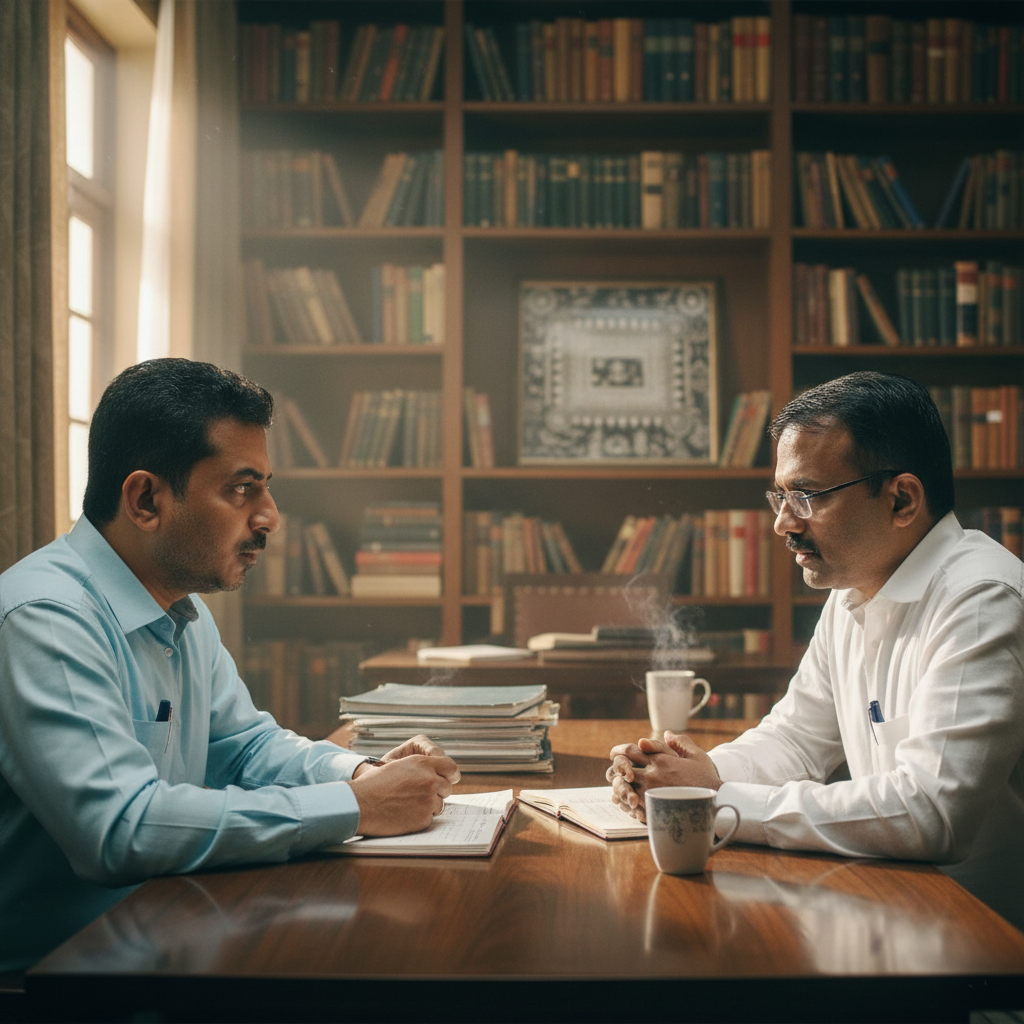
The corridors of Maharashtra’s Mantralaya are not known for silence. Files move. Peons hurry. Officers glance at wristwatches. The air carries the particular urgency of governance — deadlines, decisions, and the low hum of power that never quite settles. It is, by design, a place of doing. Rarely a place of being.
And yet, on an otherwise unremarkable afternoon, in a small room off one of those busy corridors, philosophy arrived — unhurried, uninvited, and utterly at home.
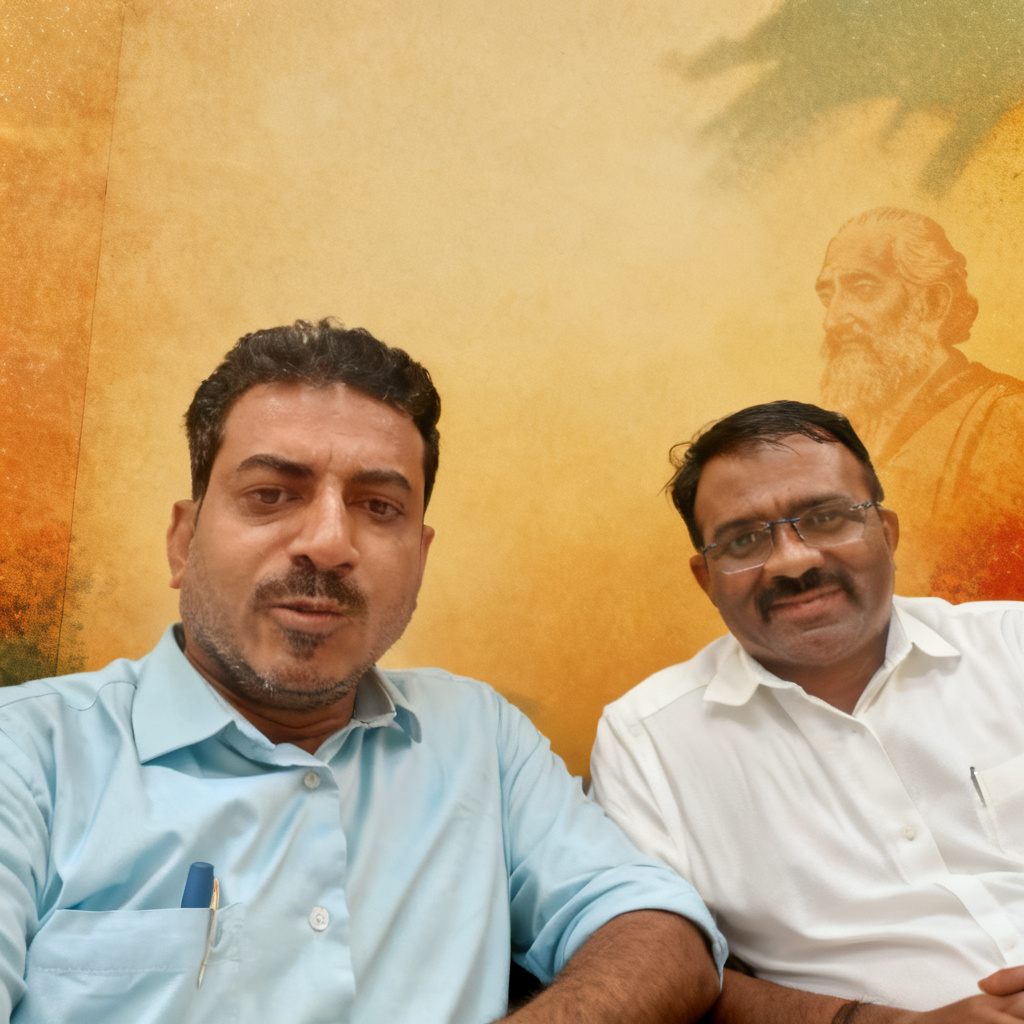
I had come to Mantralaya for reasons of routine. What I did not expect was to spend the next two hours in the company of a man who had spent a lifetime navigating the distance between the world outside and the world within. My friend Sharad Bhingare sat across from me, a slight smile on his face, a calm in his eyes that felt oddly out of place among the fluorescent lights and government furniture — and yet, somehow, exactly where it belonged.
The Scholar Who Resists a Single Label
To introduce Sharad Bhingare by his qualifications alone would be to miss the point entirely — though his qualifications are, by any measure, remarkable. He holds an M.Sc. in Agriculture from MPKV Rahuri, an M.A. in Marathi, an M.A. in Philosophy, and has cleared both NET and SET. This year, with a quiet audacity that is entirely characteristic of him, he has set his sights on clearing NET-SET across six subjects simultaneously. Not as a career strategy. As what he might simply call — curiosity.
But credentials, as Sharad himself would be the first to say, are the beginning of a conversation, not the end. The man who sits before you has read the Dhammapada in its original Pali spirit. He has wrestled with Nietzsche at midnight and found unexpected peace in Lao Tzu at dawn. He carries Krishnamurti in his pocket the way others carry worry beads.
What makes Sharad unusual is not the breadth of his reading. It is the quality of his attention — the way he does not merely read thinkers but seems to have lived alongside them, testing their ideas against the grain of his own experience.
The Fire That Krishnamurti Lit
“It began in my first year of B.Sc.,” he told me, almost as an aside. “I picked up Krishnamurti and something shifted.”
Jiddu Krishnamurti — that singular, unclassifiable philosopher who dissolved the very institution of spiritual authority — had told his followers, with radical directness: Do not follow me. Find your own truth. For most, this is an uncomfortable invitation. For a young agricultural science student from Maharashtra, it became a compass.
From Krishnamurti, Sharad moved outward in concentric circles. Swami Vivekananda and Ramakrishna Paramhansa gave him the fire of devotion wedded to intellect. Gautama Buddha’s Dhammapada offered a psychology of suffering so precise it might have been written yesterday. Mahavira’s absolute non-attachment — what Sharad described as a “voice of the absolute” — posed a challenge that no comfortable philosophy can answer quickly.
He did not stop at the saints. He went deeper into the soil of Maharashtra’s own tradition — the devotional poetry of Sant Dnyaneshwar, the earthy wisdom of Sant Eknath, the fierce compassion of Sant Soyrabai. But it was Tukdoji Maharaj and Gadge Maharaj who brought him to what he called the perennial question: Is philosophy only for the individual, or does it belong to the collective? These two saints, in their very different ways, had answered with their lives: real wisdom must liberate communities, not merely console individuals.
A Doctor Who Chose to Let Go
It was at this point in our conversation that Sharad paused — the kind of pause that precedes something important — and mentioned a name I knew well.
Dr. Narayan Maharaj Jadhav. A doctor from my own village in Ahmednagar district. A man who had built, over decades, a thriving medical practice — the kind of established, respected life that families dream of. And then, forty years ago, he had walked away from it.
Not from failure. Not from despair. But from a decision so quiet it made no noise at all.
He had turned, with complete seriousness, to the Bhagavata, which he read not once or twice but a thousand times. He spent his remaining years immersed in the Narada Bhakti Sutra and the Shandilya Bhakti Sutra, exploring the architecture of devotion from the inside. No clinic. No certificates on the wall. Just a man and the text and the long, patient work of understanding.
“Wisdom,” Sharad said, his voice dropping slightly, “is not revealed by what a person accumulates. It is revealed by what they are willing — genuinely willing — to let go.”
The room held that sentence for a moment. Outside, somewhere down the corridor, a phone rang. A door opened and closed. Mantralaya continued at its usual pace. But inside that room, something had gone very still.
This is also the tradition of Nisargadatta Maharaj — the great Advaita Vedanta master who lived not in an ashram or a university, but in a modest tenement in one of Mumbai’s humblest neighborhoods, and from there produced teachings so profound that Maurice Frydman carried them across the world. Sri Sri Sitaramdas Omkarnath. The lineage of those who found everything by claiming nothing.
East Meets West in the Mind of One Man
What makes Sharad’s intellectual journey genuinely rare is not that he reads Eastern philosophy or Western philosophy — but that he refuses to observe the border between them.
He spoke of Lao Tzu’s Tao with the same ease with which he discussed Mahavira. The Tao Te Ching’s central invitation — flow with life, do not force it — is, he suggested, not so different from what the Bhagavad Gita calls nishkama karma. The commentary tradition on the Gita itself, he noted, reflects extraordinary diversity: Maharshi Aurobindo read it as a manual for integral evolution; Lokmanya Tilak as a call to action; Mahatma Gandhi as a sustained argument for non-violence. Three readings of the same text — three entirely different civilisations of thought.
Moving west, Sharad moves without hesitation. Immanuel Kant’s insistence on the limits of pure reason. Spinoza’s vision of God and nature as inseparable. Schopenhauer’s philosophy of will and suffering — which, Sharad pointed out, bears a striking and largely unacknowledged debt to Buddhist thought. Nietzsche’s furious, prophetic questioning of all inherited values. Bertrand Russell’s cool analytical scalpel.
Then there are the existentialists — Kafka, in whose novels the individual wanders a bureaucratic maze without exit or explanation (I looked around the room and thought: he might have set a novel here). Camus, who insisted that the only serious philosophical question is whether life, in the absence of certainty, is worth living — and answered, with characteristic stubbornness, yes. Freud, who mapped the underworld beneath the surface of the rational mind. Rousseau, who asked whether civilisation itself might be the problem.
And then — the moderns. Viktor Frankl, who survived the death camps by discovering that meaning, not pleasure, is the deepest human need. Carl Jung, whose concept of the collective unconscious suggested that we are haunted not only by our personal history but by the entire history of our species. Khalil Gibran, who wrote philosophy as poetry and poetry as prayer. Eckhart Tolle, whose entire teaching rests on a single proposition: the present moment is all there is. A proposition that sounds simple until you try to actually inhabit it.
And the Dalai Lama — whom Sharad had met in person. “What I noticed,” he said quietly, “was not what he said. It was the quality of his presence. He was entirely there.“
Identity Beyond Designation
Late in our conversation, I asked Sharad what, after all this reading, all this inquiry, he had actually found.
He was quiet for a moment. Then he said: “Know yourself beyond your profession.”
It is a deceptively simple sentence. But sit with it long enough and it begins to unsettle. In a place like Mantralaya — where identity is almost entirely constituted by designation, department, and designation number — it lands with the force of a quiet provocation.
We are trained, from the earliest age, to answer the question who are you? with what we do. I am a journalist. I am a civil servant. I am an agriculturalist. These are not wrong answers. But they are incomplete ones. Beneath the designation is a person. Beneath the person is a consciousness. It is that consciousness — and not the visiting card — that every serious philosopher, from the Upanishads to Eckhart Tolle, has insisted is the true subject of inquiry.
Sharad does not preach this. He does not perform it. What makes him credible is precisely the absence of any desire to convince. He has arrived, through decades of reading and reflection, at a kind of settled openness — curious without being anxious, learned without being proud.
What Philosophy Does in a Bureaucratic Corridor
As I walked out of Mantralaya that evening, into the salt-tinged Mumbai air, I found myself thinking about what had just happened — and why it felt so unusual.
Philosophy has always had an uncomfortable relationship with power. Socrates, its first great martyr, was executed by the democratic state for asking inconvenient questions. The great medieval philosophers worked under the constant anxiety of orthodoxy. Even in our own time, genuine philosophical inquiry — the kind that questions assumptions rather than confirms them — is rarely welcome in the corridors of governance.
And yet, what Sharad Bhingare embodies is a kind of quiet insistence that philosophy is not a luxury for the leisured, not a discipline for the academy alone. It is, as Tukdoji Maharaj and Gadge Maharaj knew, a practice for the living. It belongs in agricultural universities and government offices and cramped Mumbai apartments and village clinics abandoned in the name of something larger.
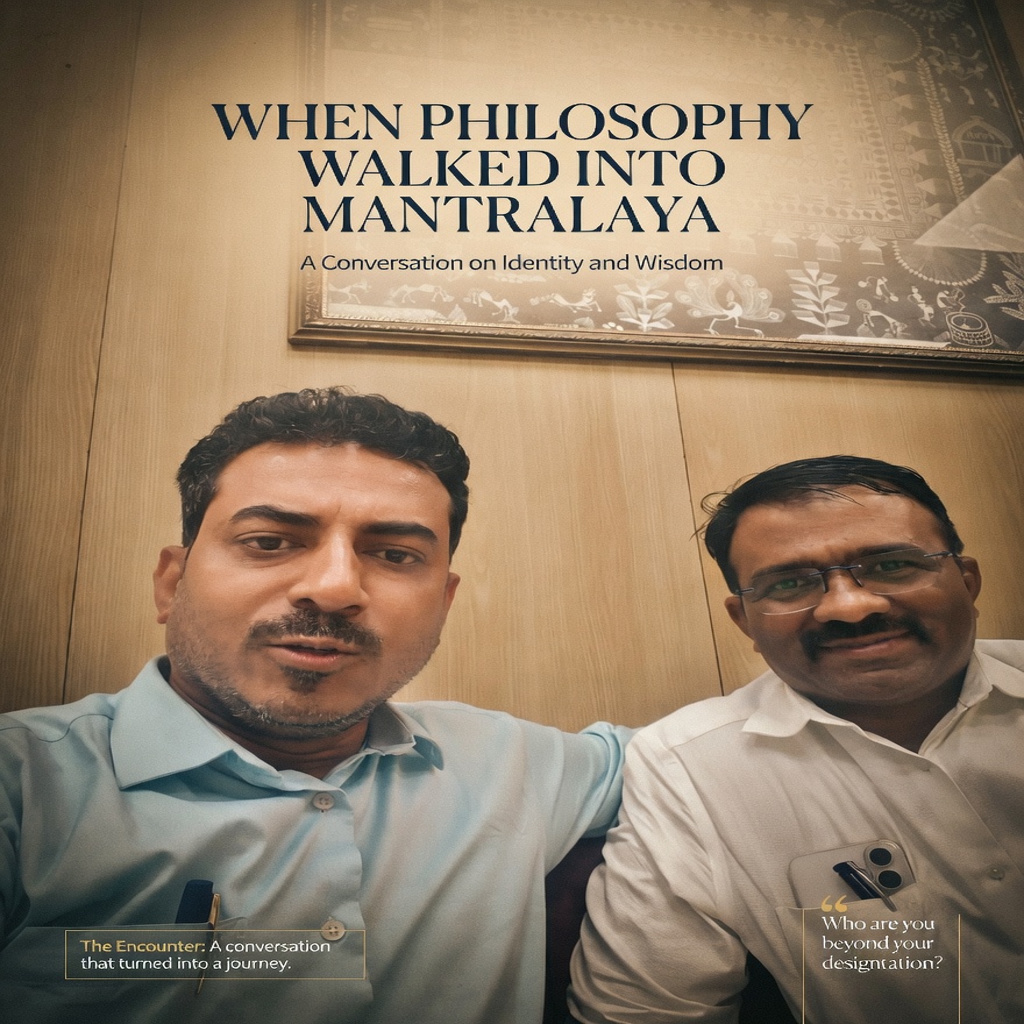
It belongs, even, in Mantralaya.
The corridors were emptying as I left. The last of the day’s files had been moved. The decisions had been made or deferred. And somewhere behind me, in a small room lit by fluorescent light, the questions that have no final answers continued — as they always have — to ask themselves.
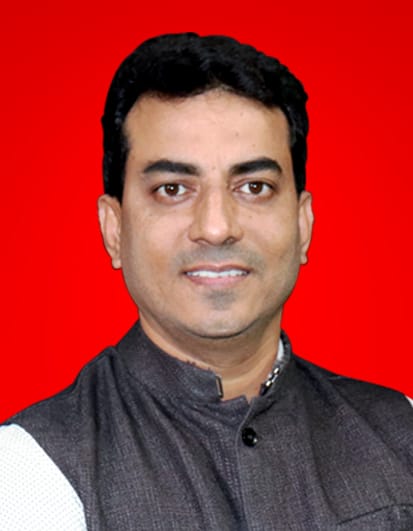
Vijay Gaikwad is a senior agricultural journalist, policy analyst, and advocate based in Mumbai.